The Role of Therapy in an Age of Existential Crisis
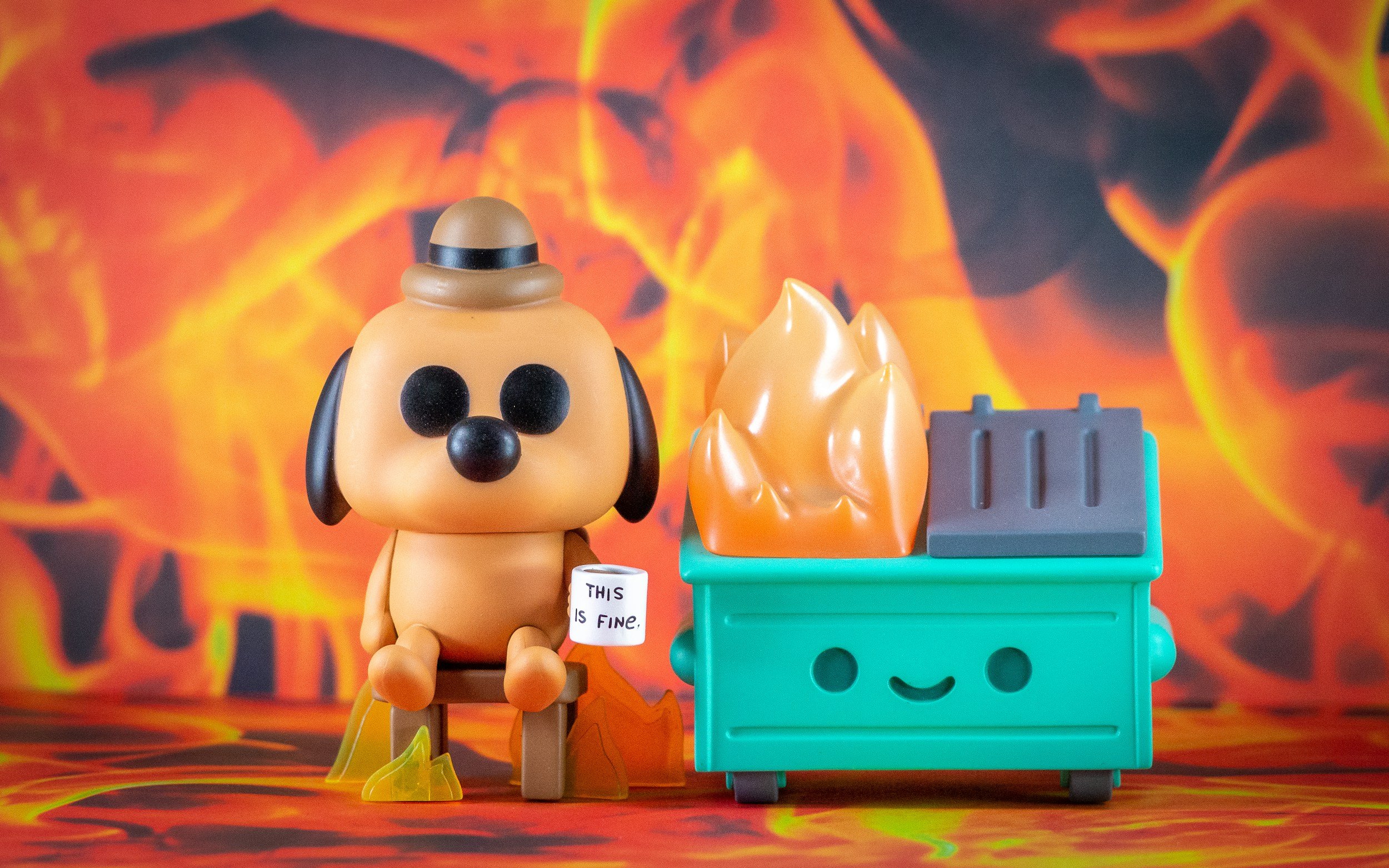
We are living through a time of global existential anxiety, not just stress, but deep dread that touches something primal. As a therapist, a human, and someone trying to stay present in a rapidly unraveling world, I find myself asking: What does it mean to be well, to support others, when the world feels like it’s burning?
Watching the World Burn
There’s this surreal feeling of existing in life right now - going through the motions while subconsciously or consciously we’re aware that the world is on fire and our institutions are failing and the infrastructure that we rely on for order and progress as a society - as PEOPLE who are reliant on our society - is in dire peril. It’s a very real threat that I feel bowled over by. Like watching a train I’m riding in about to go over a cliff and I can see it happening and yet I’m powerless to stop it.
Most of my clients report some version of this:
Free-floating anxiety
Loss of containment, meaning, and direction
Extreme difficulty falling asleep and waking up exausted
Over-engagement followed by shutdown
A compulsive need to understand, fix, or escape
And a profound sense of powerlessness
When the Threat Is Real, But Not Immediate
What I’m describing, I believe is that I’m feeling the existential anxiety of the issues most relevant to our time. The monster in the basement is out, it is alive and real. Very real. So contrary to commonly taught CBT techniques that teach us to contradict our irrational beliefs as a means to find relief from anxiety. What are we supposed to do when the threat is real? Sometimes the anxiety isn’t irrational. Sometimes the world is on fire, and your body knows it.
Quick Neurobiology Fact:
We’re wired to respond to real, immediate danger. Our stress response system can handle the bear charging at us.
We can run, we can fight. The trouble comes when the threat is real but abstract - slippery, chronic, unfixable by one person.
That’s the unique anxiety of our time: we sense the catastrophe, but there’s nowhere to put the energy. No one action that makes it stop.
What are we supposed to do then? Keep reading, I promise I’ll bring some light and hope in.
Doomscrolling, Avoidance, and the Search for Regulation
Doom-scrolling is bad for your mental health. It keeps us tethered to the threat and terror of unmanageably huge crises and problems that no individual can do much of anything about on their own. When my clients are stuck in this spiral and struggling to cope with the dumpster fire that is current events, we often work on body-scanning, taking breaks, and anchoring into relationships or causes on which they can have a tangible impact.
But the opposite, total avoidance, isn’t a solution either.
When I’ve disconnected entirely, I’ve found myself under-informed, yet still anxious and disturbed by what I couldn’t bear to acknowledge. Avoidance doesn’t insulate us. It’s a low level defense rooted in instinctual compulsion from our nervous systems. But we are still affected by the things we cannot tolerate to think about. Sometimes in ways that are hard to articulate.
I tend to avoid because I fear that engaging will destabilize me. I worry about my mental stability, my tendency to get lost in dread and my propensity to fall into patterns of thinking that it is my responsibility (because it is, just as it’s yours, all of ours). The problem with me and responsibility is that my subconscious processes are dumb. I unconsciously believe there is an ANSWER and that given enough time, I will eventually come up with it. The solution that will bring about world peace. *Face-Palm*
The Myth of Individual Power (and the Need for Collective Action)
The truth is devastating:as individuals, we are limited. And I think that’s the experience of being anyone who is not a billionaire right now. There is something really and terribly wrong. The threat is real. But as one person who is beholden to the people and systems that are in power, I feel utterly powerless and insignificant to make a difference of any kind. And in some ways that’s license for me to avoid, shut down, pretend that I’m doing all that I can by fighting the good fight day in and day out. These words were echoed back to me recently and I realized… How many of us are bypassing our existential dread because it is unbearable and overwhelming? The idea that we can manifest our way to world peace is a dangerous illusion that prevents us from engaging in real action.
We only have power as a collective. And in some way we all also know that as well. But we all hate group projects and we don’t know how to cooperate with each other as well as a litany of other complex reasons that collective action feels nearly impossible. Not to mention that we live in a time of extreme isolation and disorientation.
It’s very human to long for a savior. To project our hope onto The Right Politician or The Right Movement.
But I think the truth is much harder and much scarier.
I don’t believe in being saved. I believe in participation.
And that’s a harder ask.
The only way to truly fight is to show up and stand for what you stand for with the limited resources at your disposal. This is so hard. And you might feel that you barely have enough resources to keep your life afloat. I hear you. I don’t want you to drown in guilt that you should be doing more than you’re capable of. I want you to see taking care of yourself as a necessary and vital step in being part of a bigger change.
What Can You Do (Without Collapsing)?
If you’re overwhelmed, if your head is barely above water: that’s the work. To get grounded, regulated, resourced. That is where you start.
Start Here - Radical Self Care:
Work on your barriers to getting good rest, eating regularly, and hydrating (the amazingly hard challenges of self-care)
Work on your barriers to understanding and navigating your emotions
Work on your barriers to sharing space with others
Work on your barriers to identifying and managing your resources of time and money
For Levelling up - Radical Community Care:
You know those politicians I mentioned earlier? Give them money. Even $5 to a campaign or mutual aid fund is significant in ways that our minds don’t usually let us understand.
Get curious about what’s happening in your local community and see who the players are and what the issues are (this could include getting involved or even just following a newsletter for a local org)
Start conversations with people you trust and allow people to be confused, grapple with ideas together
Evaluate your real skills and resources that you can contribute to the changes you want to see in your community. Don’t feel like you have to do everything and don’t overcommit yourself. Be realistic about what you want to do and can do sustainably. Don’t discount the small and hard ways you’re being generous and embodying your values.
Keep showing up for yourself, for your values
Radical self-care is an act of rebellion and brings you closer to being able to participate in a more meaningful way. When you’re feeling especially helpless, the most radical thing you can do is take care of yourself - and sometimes that is unpleasant and we don’t feel like it.
The goal isn’t perfection. It’s presence.
When you collapse, rest. Then get up again.
When you avoid, notice, and gently return.
And when you return, return to the places you can actually have a substantial difference. That’s going to be small and local. Embodied values require action. Even and especially actions of compassion and care for ourselves as much as for others. Where is your growing edge? Where are you hiding from the world where you can grow a little bit more?
So Where Does Therapy Fit In?
It’s at times like this that I think the skills and support offered by therapy is the most important it has ever been. Therapy is the weirdest, most nebulous of medical treatments. It’s not exactly science, not exactly art, not exactly spirituality. But it borrows from all of these disciplines into some weird existential whole.
My role as a therapist isn’t to fix you. It’s to help you feel strong enough, clear enough, and supported enough to participate.
To help you:
Build resilience
Come home to your values
Stay grounded in your body and your relationships
Be a part of a larger healing process. Not because it’s easy, but because it matters
We are not meant to do this alone. And we can’t.
My Dream
I have a fantasy that with each person I help to be more present, more capable of handling the challenges of their lives, more capable of feeling the power and meaning and value of their individual life, that there is one more person who will join the battle of our time.
The battle isn’t between Republicans and Democrats. It’s not (just) between fascism and communism. It’s not even (just) between the haves and the have-nots. While all of these are very real concerns, the battle I want to call your attention to is far more subtle and complex than that. And it’s battleground is both internal and external.
Therapy claims to treat an individual, but what is an individual? What are we? We think we are so separate - and in a way, we are. We are unique creatures with our own aliveness, our own struggles and wonders and needs and limitations. But we are profoundly reliant on each other in an inescapable way. We may be terrified of other people. We may isolate. We may think we have nothing in common with THOSE people out there, especially the ones who voted for the wrong person. But we are one people and we share one home. It is irreplaceable.
How do we maintain and honor our differences, our unique identity and needs, and stay in connection as a community?
How do we SHARE this Earth with people who might hate us, who we might hate?
How do we maintain our integrity and boundaries without giving in to the defensive strategies of othering - of kicking people out of the tribe because we don’t know how to handle them? This is one of the biggest existential crises of being human in any time.
If hope is to survive, we need more people to be present, aware, and invested in the outcome. This is a terrible thing to ask of you. It’s a terrible thing to have to live with.
I don’t think any of us are equipped with the emotional resilience, flexibility, and skill to handle this challenge. We must grapple with it anyway, and we must do so together.
An Invitation
If you're feeling the weight of this moment, and if you're ready to stop navigating it alone, therapy (both individual and especially process group therapy) might be a place to begin to build your capacity for radical self-care and to increase your ability to participate in life.
I work with people who feel deeply, think intensely, and are searching for ways to be both realistic and hopeful in an overwhelming world. Together, we can build the resilience to stay present. Not just to survive, but to participate.
👉 Ready to start? Join my email list for reflections, resources, and inspirations to stay alive in uncertain times. Or reach out here to explore working together.
You don’t have to carry this alone.
You were never meant to.
May the Force be with you.
Leanna
