Still Standing: The Nine of Wands, Relational Pain, and the Power of Unconscious Patterning
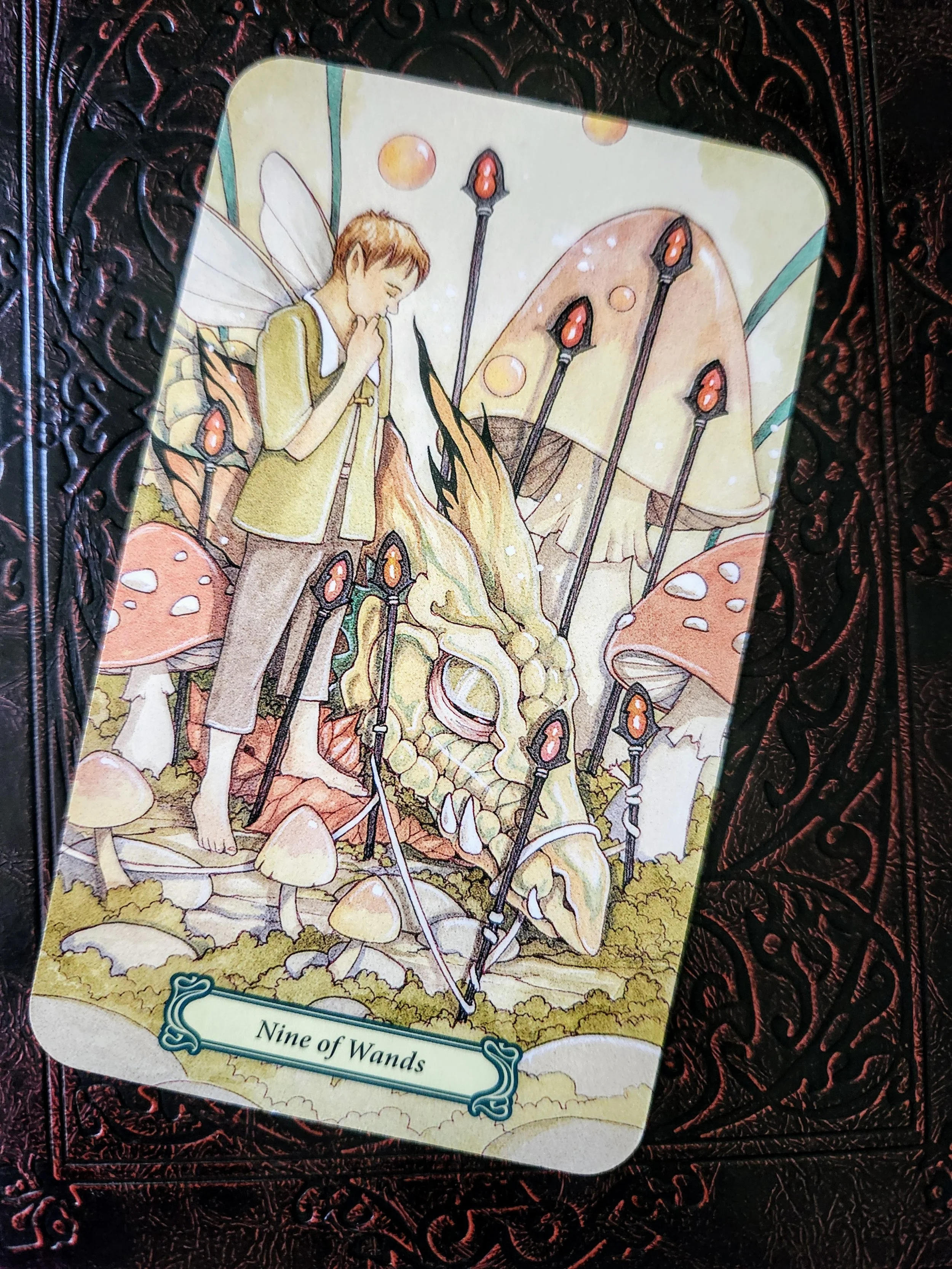
Nine of Wands
from Mystic Faerie Tarot by Linda Ravenscroft
When the short interpersonal process group I participated in ended, I pulled a tarot card to help me understand what the experience had stirred in me.
I drew the Nine of Wands: a figure who is visibly hurt, watchful, and tired, but still upright. Still guarding something vulnerable. Still trying.
It was the right card.
But not in the “I did something brave and it paid off” way.
More in the “I did something brave, it reopened old wounds, and I’m still here trying to make meaning of that” way.
The Familiar Ache of Being Too Much
As someone with AuDHD (Autism and ADHD) and a long history of relational trauma, group spaces hold both promise and threat. I long for connection, but I also enter with armor I don’t always realize I’m wearing.
In this group, I was emotionally activated in familiar ways… feeling like my inner world was too large for the room, my pain too unfiltered, my presence too charged.
And in some ways, it was.
I received subtle and explicit confirmation that my emotional expression can be hard for people to stay close to. And the familiar message that I’m bad/wrong for being this way emerged. Along with another message I’ve known but has not been verbally confirmed: that I activate shame or unprocessed pain in others.
I can’t always tuck my suffering behind palatable social language. And while I don’t believe I should have to, I also recognize there is a very real interpersonal cost to that.
In this group, I received a lot of feedback. Some acknowledged the avoidance. Some shared admiration. Some offered criticism. Some offered kind words. Others stayed quiet.
It was all true.
But my brain, shaped by trauma, fixated on the pain. On the disconnections. On the moments that mirrored past experiences of being alone in my emotional reality.
The Complexity of Accountability
I want to be honest with myself: I wasn’t at my most relationally skillful in this group. When I’m stressed, my communication narrows. I lose flexibility and nuance. I can sound more intense than I feel. I struggle to attune. My need for connection becomes a kind of urgency that I don’t always know how to regulate.
That doesn’t make me the villain in my own story, but it does remind me that self-awareness isn’t the same as self-mastery. It reminds me that while some of my interpersonal challenges are neurological and not fully in my control, others are shapeable over time. And it’s okay to keep working at it.
Multiple Truths, One Nervous System: What Happens When Not Everyone Sees You the Same Way
One of the most surprising, and unexpectedly impactful, aspects of the group was discovering that not everyone shared the same story about me.
I’ve lived most of my life under the shadow of being “too much.” Too emotional, too intense, too quick to go deep. And in group, that wound got activated. I absolutely felt that some people kept distance from me. I felt misunderstood, hard to reach, sometimes even avoided.
But not everyone experienced me that way.
Some people named me as impressive, admirable, or even essential to the group process. There was a moment when someone expressed a desire for inclusion, and it included me. There was at least one person who clearly struggled but still made an effort to hold space for me, awkwardly, imperfectly, but with intention. Others said they wanted to see more sides of me. To know me more fully.
These moments mattered.
Because my brain, like all brains shaped by trauma, is wired to spotlight danger, not safety. Evolutionarily, we’re primed to notice what might go wrong. For trauma survivors, this survival wiring gets sharpened into a kind of emotional hyperacuity: scanning, bracing, interpreting silence as rejection, neutral tones as threat.
We latch onto the familiar pain because, on some level, it feels safer to expect harm than to risk the vulnerability of hope.
So when multiple truths about me appeared in the room, some painful, others warm, it was almost disorienting. But also liberating.
Projections, Roles, and the Courage to Not Figure It All Out
Part of what makes group work so potent and so challenging is that we don’t just meet each other. We meet each other’s histories.
We cast people into roles drawn from our pasts: the cold mother, the judgmental peer, the distant sibling, the rescuer, the threat. And we do this unconsciously, as a way of trying to finally resolve what hurt us.
In this group, I felt myself being cast. And I know I did some casting, too.
It’s what the psyche does when it’s trying to protect itself. When it’s reaching for familiarity, even when the familiar thing is pain.
There’s a part of me that still wants to figure it all out. Who saw me clearly, who didn’t, what it meant, whether I should have done things differently? That part lives in my prefrontal cortex, endlessly analyzing, searching for clarity as a substitute for safety.
But not everything can, or should, be neatly known.
Some of the most transformative moments in group came not from making sense of the dynamic, but from surrendering to it. From staying with the emotional mess of it long enough for something to shift on its own.
That’s what the unconscious does when given time: it reveals, it re-patterns, it integrates. But only if we can stop clinging to certainty long enough to let it move.
Healing doesn’t just happen through insight. Sometimes it happens through presence. Through letting go.
The Wish for One Kind Story - and the Freedom of Letting Go
Of course, I wanted there to be a consensus: that I was good, insightful, warm, worthwhile. That I belonged. That my intensity wasn’t just tolerated but welcomed.
I still want that.
But I’m learning that the cost of trying to control the narrative is too high. I don’t get to choose how people see me. And clinging to that wish can keep me from recognizing the actual kindness that’s present. Kindness that doesn’t always look the way I want it to, or come from the people I wish it would.
It’s humbling, and also freeing, to realize that truth in group is plural.
It’s emotional quantum mechanics: I was intimidating and admirable. I was misunderstood and essential. I was avoided and desired. All at once.
And maybe healing doesn’t come from finally being seen the right way, but from recognizing that no single perception defines me. That other people’s experience of me, be it positive, negative, or mixed, is real, but not the whole truth. And never the absolute truth.
Time, Potential, and the Unconscious
This group was short by design, three sessions. And I want to be clear: I don’t believe it was too short. It was what it was. I signed up knowing the time frame.
It was enough to stir things, not necessarily enough to metabolize them.
And near the end, someone named that: what could have unfolded with more time. That maybe we were just beginning to land in something real. That reflection stayed with me.
So did the reminder that in all group spaces, our unconscious is at work. It protects and distorts. It lifts up some things and hides others. We don’t see clearly while we’re in it. We only see the parts we’re most primed to see.
For me, that’s often rejection.
It’s taken time to notice the other parts: the admiration, the care, the small moments of resonance that didn’t register at the time because my nervous system was busy trying to survive.
What the Nine of Wands Means to Me Now
The Nine of Wands isn’t just about perseverance.
It’s about the kind of bravery that doesn’t look like strength. The bravery of staying present inside a nervous system that wants to flee. Holding complexity when your inner world is screaming for clarity. Sitting with the ache of almost-connection.
It’s about seeing yourself clearly, even when it hurts. And not making yourself the hero or the martyr, just the person trying, again, to be known.
Why My Groups Last Longer
This experience affirmed, gently but clearly, why I structure my own groups with a longer commitment - twelve weeks instead of three. Not because short groups can’t be meaningful, but because for many neurodivergent folks, depth takes time.
Our nervous systems often need longer to metabolize relational experiences. Slower processing, heightened sensitivity to emotional and sensory input, and a tendency toward deep internalization mean that what happens in the room might not fully register until much later. What felt like “nothing” in the moment can bloom into insight, or hurt, days afterward.
We often need time to come down from the flood, to parse what was ours and what belonged to someone else, to return to the body after dissociation or overwhelm. Time to re-enter with more clarity. To try again without collapsing in shame.
My hope is that twelve weeks is a start to allow for that unfolding.
Time to feel the activation and stay.
Time to misstep and repair.
Time to rewire the belief that you’re too much, too intense, or too incomprehensible to belong.
For those of us whose processing doesn’t follow a neurotypical pace, that extra time isn’t just a luxury - it’s a necessity. It’s what allows us to participate without abandoning ourselves.
For Those Who’ve Had Mixed or Painful Group Experiences
I want to say this to you gently: you didn’t fail.
You may have felt too much, but you weren’t wrong for showing up as you are.
You may have made others uncomfortable, but that doesn’t mean you were unsafe.
You may have focused on the painful parts, but that’s often what trauma does. It pulls our attention toward what confirms the story we already carry.
The truth is probably more complex.
There were moments of care. Of resonance. Of being seen, even if only partially.
And maybe that’s enough to try again.
If you’re looking for a group space where there’s time to be misunderstood and then understood, to take up space and soften into it - The Haven might be for you.
It’s a group for neurodivergent folks who are tired of masking and ready to feel seen in real-time relationships. It’s slow. It’s imperfect. And it’s committed to staying long enough to matter.
Intrigued? Fill out a low commitment interest survey or reach out today to find out more about joining one of my groups.
Let’s practice the kind of relating that honors complexity, contradiction, and the courage it takes to keep showing up.
May the Force be with you,
Leanna Greenberg, LMHC/LPC
(licensed therapist, trauma-informed, neurodivergent-affirming)
